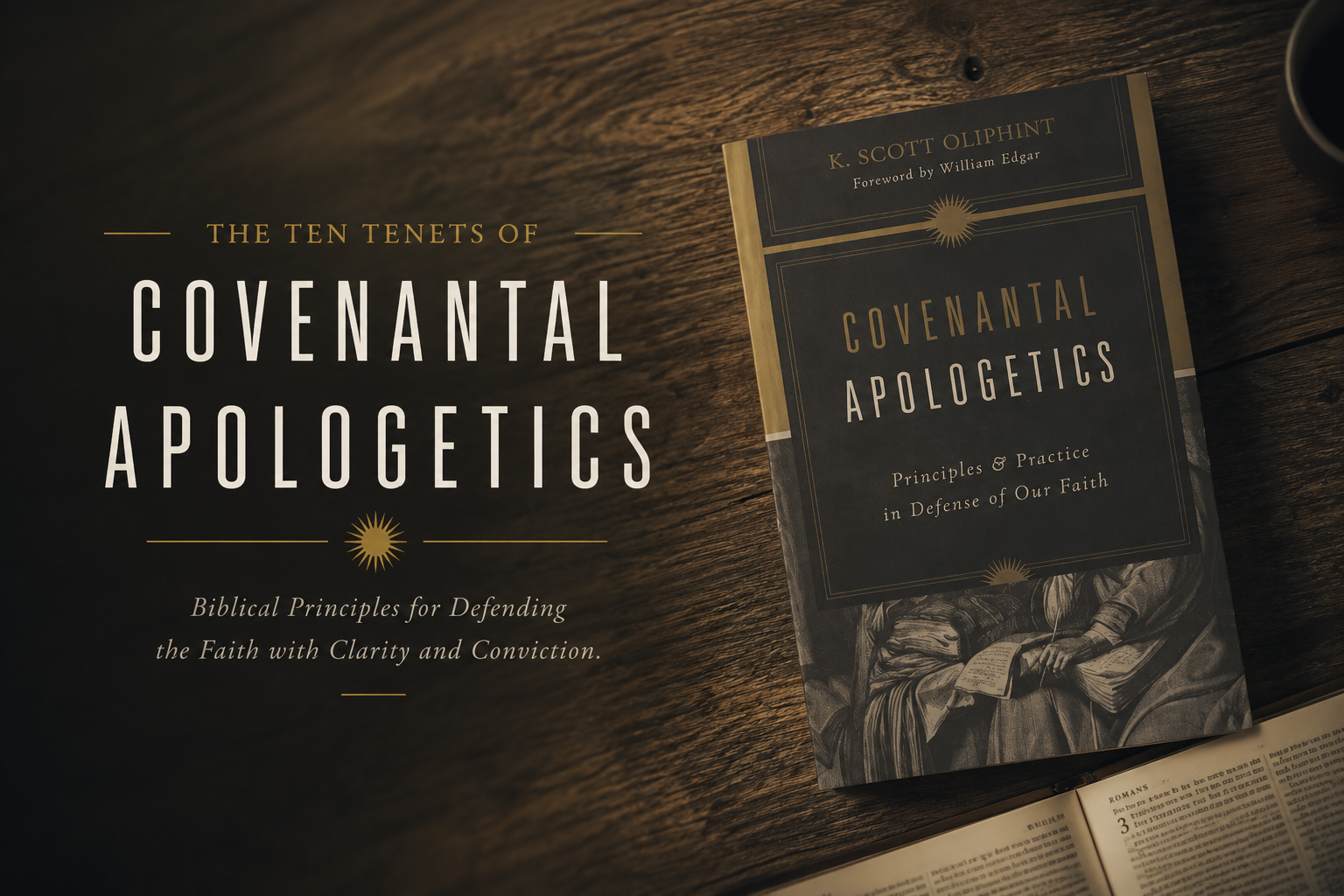
Note To Reader: These are notes and excerpts from Covenantal Apologetics by K. Scott Oliphint.
Presuppositional Apologetics is the system and even art of defending our faith. Covenantal Apologetics by K. Scott Oliphint was the first book on theology I had ever read. When I first read the book, I didn’t quite grasp all of the concepts. But I knew that it was rich value to me. Earlier this year, I reread this book with a stronger understanding of apologetics and the biblical worldview and was pleasantly surprised to find that it was still edifying for me ten years later.
If you are new to apologetics, read these 10 tenets and take them to heart. If you have a background in this area, I hope this is still enriching for you.
The faith that we are defending must begin with, and necessarily include, the triune God- Father, Son, and Holy Spirit-who, as God, condescends to create and to redeem
Generic theism has no part of the Christian faith.
The Trinity is such an inherit characteristic of God, The starting place must be at the triune God as a presupposition.
God’s covenantal revelation is authoritative by virtue of what it is, and any covenantal, Christian apologetic will necessarily stand on and utilize that authority in order to defend Christianity.
God’s revelation is covenantal because it initiates a relationship between God and humanity.
The authority of scripture is taken as the word of God.
It is the truth of God’s revelation, together with the work of the Holy Spirit, that brings about a covenantal change from one who is in Adam to one who is in Christ.
We are required to communicate God’s truth when defending the Christian faith.
Apologetics proclaims truth, but regeneration remains sovereign.
Avoid rationalism (truth alone)
Avoid mysticism (Spirit apart from truth)
Testimonium Spiritus Sancti Internum or Internal Witness of the Holy Spirit asserts that the authority of Scripture is self-authenticating and established not by human reason, church tradition, or external proofs, but by the inward work of the Holy Spirit in the believer’s heart.
Man as image of God is in covenant with the triune God for eternity.
Every person is made in the image of God and is therefore responsible to God for everything that they do and are therefore in covenant with God for eternity.
Every person in covenant with God lives coram Deo, that is, before the face of God.
All people are in covenant with God as image-bearers, though only believers are in the covenant of grace.
It is by this truth, that we are responsible for our confession on the day of judgement.
All people know the true God, and that knowledge entails covenantal obligations
Romans 1:18-20 – All people inherently know God because God makes himself known by virtue of his own revelatory activity.
Those who are and continue to remain in Adam suppress the truth that they know. Those who are in Christ see that truth for what it is.
There is an absolute, covenantal antithesis between Christian theism and any other, opposing position. Thus, Christianity is true and anything opposing it is false.
The antithesis is ethical and covenantal, not merely logical.
Suppression of the truth, like the depravity of sin, is total but not absolute. Thus, every unbelieving position will necessarily have within it ideas, concepts, notions, and the like that it has taken and wrenched from their true, Christian context.
All men are affected by sin (Total Depravity) but is not absolute as in absolute depravity.
Sin affects every faculty
But does not eliminate all truth, goodness, or rationalityl
The true, covenantal knowledge of God in man, together with God’s universal mercy, allows for persuasion in apologetics.
Every fact and experience is what it is by virtue of the covenantal, all controlling plan and purpose of God.
You are not an apostle and you do not know a living apostle.
From the protestant perspective, the early church was not interested in staking a claim in apostolic succession in the way that we think about it today. Our first thought on this topic is often to think about the Roman Catholic Church or the Orthodox Church, however, there were many smaller groups that also did this. The claim was to have “X Apostle Christianity”, whether Peter, Andrew, Thomas, or another, so that they were more influential. The gnostics in the ancient era utilized this idea to push their mystical theology.
This is also how the later developed pseudepigraphal writings influenced some groups (such as the gospel of Thomas, which is a known forgery). Because it was beneficial for these movements to have a supposed original manuscript from their apostle for their influence. So in order to differentiate themselves from these splinter groups, the church leaders labeled themselves: Catholic, as in “of the whole”. Of course, the Catholic Church we all know today now pronounces themselves to follow Peter. But that is church history for you.
For now, this particular article is not focused directly on the Roman Catholics or Eastern Orthodox churches but actually looking at protestant groups that utilize the title of apostle for a claim of legitimacy despite clearly unbiblical.
(Ex. New Apostolic Reformation, Apostolic/Oneness Pentecostals).
What is an Apostle?
So who is an apostle and how does one become an apostle? Well this is where most get lost and it’s completely understandable at times. Apostle comes from the Greek word: “Apostolos”
Apostolos – A delegate, messenger, one sent forth with orders
This wasn’t just a title invented to give to the twelve. This is an actual word that actually means something to the people who wrote it and to the intended audience in koine Greek. So this issue is that an “apostle” is both what Jesus referred to his core disciples as, and it also means to be a messenger.
This means that if you take two verses such as these:
Eph. 1:1 – “Paul, an apostle of Christ Jesus by the will of God, To the saints who are in Ephesus, and are faithful in Christ Jesus:”
Hebr. 3:1 – “Therefore, holy brothers, you who share in a heavenly calling, consider Jesus, the apostle and high priest of our confession,. . .”
You can clearly see that it makes no sense to make “apostle” mean the same thing in both contexts, if you make it mean “chief authority, disciple to Jesus, or church planter”. Is Jesus merely an apostle? Of course not. But if you replace it with, “messenger”, suddenly it makes sense.
The Argument
Critics raise up multiple counterpoints to the conclusion above. It usually stems from misunderstanding text such as Romans 16:7.
“Greet Andronicus and Junia, my fellow Jews, who were in prison with me. They are highly respected among the apostles and became followers of Christ before I did.” (NLT)
Did you know that this can also be rendered like this:
“Greet Andronicus and Junia, my kinsmen and my fellow prisoners. They are well known to the apostles, and they were in Christ before me.” (ESV)
“Greet Andronicus and Junia, my kinsfolk and my fellow prisoners, who are outstanding in the view of the apostles, who also were in Christ before me.” (NASB)
All of these are in a sense “correct” when it comes to word-for-word rendering of the text. The first question is, “Is Junia in this group of Apostles?” and the second is, “Is this group of apostles the twelve or a group of messengers?”. The key phrase is “ἐπίσημοι ἐν τοῖς ἀποστόλοις” (outstanding among or well known to).
To answer the first question of whether Junia is in this group is to answer whether that phrase “ἐπίσημοι ἐν” is referring back to Junia.
My Greek is still limited, so I won’t embarrass myself by trying to explain the full details, but the point is this: The ending of Greek words are changed to determine sentence structure and help convey the message. To fully understand this, we would have to fully unpack terms such as cases, declensions, and Greek syntax. But the short version of it is that the grammar used for our key phrase can produce the meaning that Junia is involved in this group but is unlikely given data provided throughout other writings. This is the consensus among scholarship actually interacting with this text in an honest manner.
Here is a link to an academic paper that covers this subject in greater detail:
Please note that this is the only paper that I have read by this author. I believe that he and his co-author cover this subject well, however, I do not know their positions well enough to fully endorse them as teachers.
So, you can see that trying to equate words by lexicon and ignoring all contextual data causes you commit an etymological fallacy. This is not solely a problem with the word, “Apostolos”. This also occurs with, “Angelos”
Angelos – a messenger, envoy, one who is sent, an angel, a messenger from God
It is much more similar than the average English reader would imagine. I’ve actually read someone claim that Paul had a demon in 2 Corinthians 12:7
“So to keep me from becoming conceited because of the surpassing greatness of the revelations, a thorn was given me in the flesh, a messenger of Satan to harass me, to keep me from becoming conceited.”
Their claim is that because the messenger is, “angelos of Satan”, in this verse, that must mean that Paul had a demon.
So, that argument must mean that Paul, apostle of Jesus, who healed, resurrected people, cast out demons, demons know his name, that Paul; He had a demon. I hope you can see that is absolutely ludicrous. The obvious answer is that angelos is carrying the meaning of messenger rather than spiritual being in this verse. It is proved by the surrounding text that Paul is talking about his weakness as a man.
What is The Point?
While interesting, what I am telling you has no practical impact on the majority of protestant Christians. But there is a small subsect that builds their identities around this subject. However, if you ask someone from this field to define apostle or defend their position with a strong biblical background, you will find that the answers vary widely. Locking down a single definition with these groups as to what exactly an apostle is, you won’t find a good answer. That is because it is used to create an infallible position of authority within the church that has an entirely subjective and fluid definition behind it.
Biblical Church Leadership
There are however two biblical positions provided for churches that are clearly outlined:
Qualification for an elder
1 Tim 3:1 – “The saying is trustworthy: If anyone aspires to the office of overseer, he desires a noble task.”
Titus 1:7 – “For an overseer, as God’s steward, must be above reproach. He must not be arrogant or quick-tempered or a drunkard or violent or greedy for gain,. . .”
episkopos – overseership, office, charge, the office of an elder
A man charged with the duty of seeing that things to be done by others are done rightly, any curator, guardian or superintendent
Qualifications for a deacon
1 Tim 3:8 – “Deacons likewise must be dignified, not double-tongued,[fn] not addicted to much wine, not greedy for dishonest gain.”
Diakonos – One who executes the commands of another, esp. of a master, a servant, attendant, minister
Now we have the role of overseer outlined here, but we don’t call our leaders “overseer”. We call them, “elder, pastor, bishop, or presbyter”. These are often terms used in conjunction with each other when speaking about the same general role of overseer.
Acts 20:28 – “Pay careful attention to yourselves and to all the flock, in which the Holy Spirit has made you overseers (episkopos), to shepherd (poimainō) the church of God…”
Many translations simply translate shepherd as “to care”.
Acts 20:17 – Paul sent to Ephesus and called the elders (presbyterous) of the church.
Presbyter is usually used in place of “older man” or “elder” or “overseer”
We even have modern conventions that do the same thing. Sometimes our pastors are called “Reverend” or “Chaplain”.
If the position of apostle were something that was to be established in our modern church, you would expect there to be this level of commentary available for that position. But you don’t see that. There isn’t any indication in the bible or in church history.
In fact, the only verse I’ve ever really heard used in defense of the modern-apostle position is Eph 4:11-12:
“And he gave the apostles, the prophets, the evangelists, the shepherds and teachers, to equip the saints for the work of ministry, for building up the body of Christ,. . . “
However, there is no indication of ecclesiology here. There are no qualifications. There are no established roles or definitions. The clear reading appears to be that the apostles here are either talking about disciples of Christ or the messengers who brought the gospel to the corners of the earth.
So what exactly is apostolic ministry for protestants? Following the teachings of the apostles appointed by Jesus.
When I read Eph. 4: 11-12, I do not see a command for churches to implement new apostles as an office. The better application of this text would be to see Paul reminding us of an important truth. This truth is that each of these roles were given by God to believers throughout time; And despite generations between the prophets and the apostles to each other, each was relevant to the church. Now, despite the time passed since the apostles, their teachings are still just as relevant today.
The conclusion
I won’t pretend to know the motivations for why someone would claim to be an apostle today. However, it wasn’t a deep search in the bible. The structure that God has plainly given us should be taken as a gift and held onto tightly. This isn’t what some would call “boring, dry, doctrine”. In fact, it is the word of God. And that should be good enough.