“Reformed Apologetics need, above all else, to make clear from the beginning that it is challenging the wisdom of the natural man on the authority of the self-attesting Christ speaking in Scripture.”
– Cornelius Van Til
In order to begin our look into charismatic Christianity, I want to start with defining what I am dubbing the “Charismatic Mindset.” What I mean when I say this is that although charismatics don’t hold to a set of creeds or confessions, like anyone, they have a series of presuppositions and beliefs that guide their thinking. If you don’t know yet, addressing presuppositions is a key characteristic of Christians apologetics.
- A presupposition is basically something that is assumed in advance.
These assumptions made in advance guide our thinking in the way that we examine things such as scripture and how we judge contemporary events. Everyone holds to presuppositions of some form. And they are a key characteristic of Christian apologetics. But when those assumptions remain unexamined, they quietly define the boundaries of what we believe Scripture can and cannot say.
There is some variance within the charismatic movement on theological positions. So in this chapter, we will unpack several theological positions commonly held by the specific flavours of the charismatic movement that I am challenging. I will also present arguments to them and we will explore the implications of these decisions as we move forward.
Arminianism
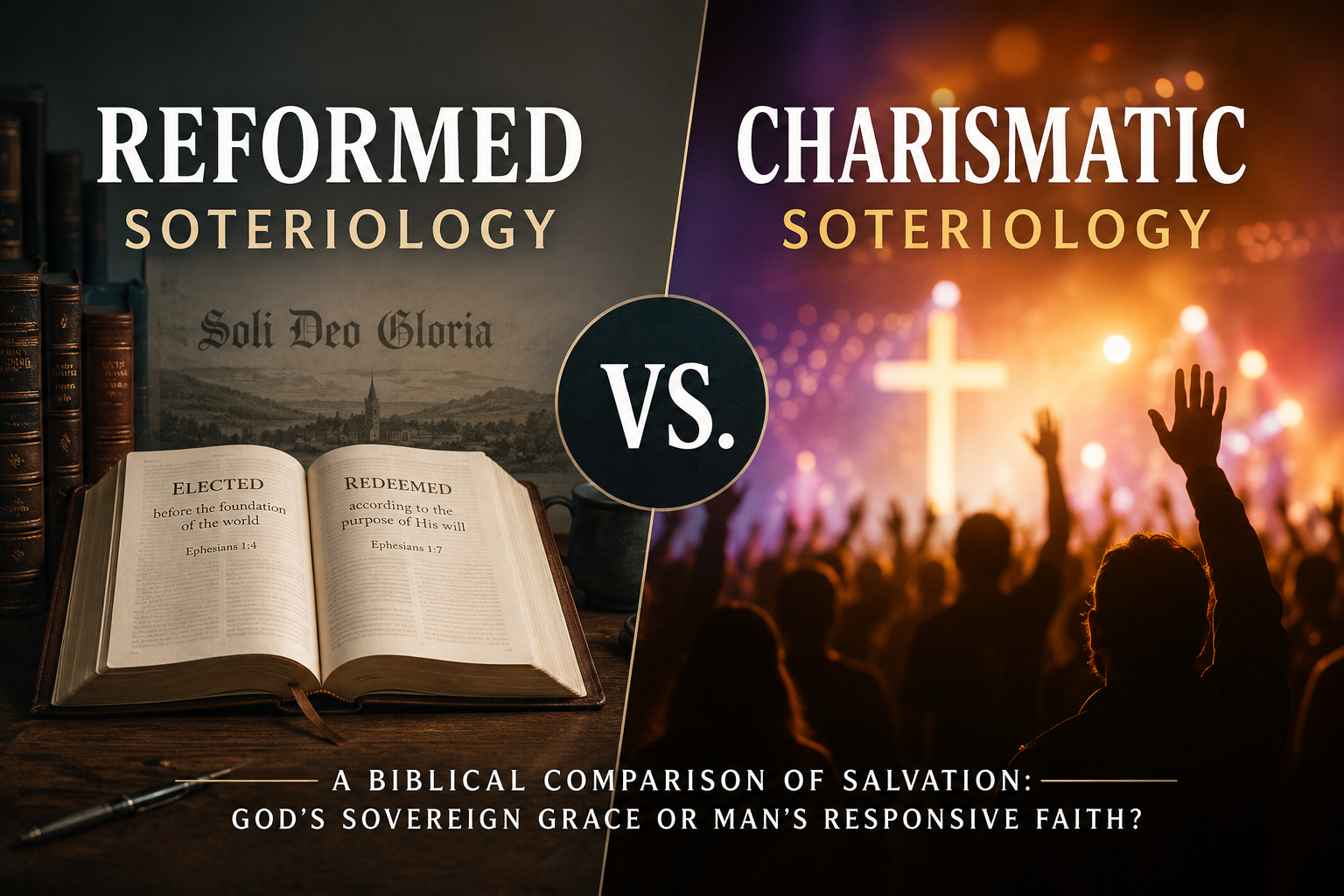
“Salvation is by God alone.” That is the beautiful thing of Christianity. This phrase is affirmed in some form by nearly every Christian group that exists. However, what is meant by those words mean different things in various circles. The reformed position would historically hold to a form of predestination with the exact definitions varying between groups such as the Calvinists and Lutherans. The unifying position however, would be the idea of Monergism (God alone initiates salvation by grace, regardless of works). The Arminian position would hold to a form of Synergism (The believer partnering with God of his own will to accept the gift of grace). This is a topic that has been hashed out throughout the centuries and we will cover more about that another time. For now, the point is that Charismatics are typically Arminian.
This is not a belief unique to the charismatic circle, but it is rarely contested in the charismatic space and drives a large portion of their theology. This is the typical modern-evangelical position on salvation that we, somehow, partner with God in salvation. It is commonly juxtaposed against reformed, predestination theology such as Calvinism.
Early on, as a charismatic, I was told that the traditional, non-charismatic crowds were cold-hearted and lukewarm believers. My leaders were not shy in saying that the reformed held to false doctrines such as being “elect” and “once saved, always saved”, and that these beliefs led to complacency toward sin despite a profession of faith.
Salvation was presented to me as a free choice where I choose God, by which I am grafted into God’s open invitation to all people. Through being grafted in, I am justified by Jesus’ blood atonement on the cross and I have salvation. After initial salvation, I walk continually with God to be further sanctified through a morally good lifestyle. This is the mode by which a charismatic would say that we are saved by faith through grace. Again, this view of salvation is common even outside of the charismatic framework. From a purely human point of view it makes sense.
The logic goes like this:
“I know I have free will because I make choices everyday.”
“A good God would not predestine me to reject Him.”
“I know God. God is a gentleman, so he wouldn’t assault my will with his own”
These are common arguments used by those who propagate this view. To many Christians, these can be compelling arguments because the prevailing culture of today has fed us an image of God that is more intuitive to the culture. As a characteristic of God, the all-powerful judge was replaced with a gentle father and sinner’s repentance has been traded for being very sorry and “giving your heart to God.” Arminians would argue that this concept of God can be found in the scriptures such as John 3:16, “ For God so loved the world that he gave his one and only Son, that whoever believes in him shall not perish but have eternal life.” The emphasis is placed on “whoever”, which is usually interpreted as “‘Whoever believes’ means that this is an open door that may or may not be taken by a person.”
However, the critic from a classically reformed position may point to Ephesians 2:1 which says,
“And you were dead in your trespasses and sins. . .”
In the following section, I am going to represent a conversation between the two positions in my honest attempt to represent both sides faithfully. Obviously I have presuppositions and I fall on one side of this argument. You are free to read and disagree. I believe the conversation would go something like this:
Critic: “If you are dead in your sins, then you can’t make a choice to follow God. God must choose you.”
Arminian: “But I did make a choice. This verse is talking about a spiritual state of sin, not a statement on whether I choose God. We reach out of the grave and God grabs our hand.”
Critic: “I disagree. When we are physically dead, we cannot choose to be alive. When we are spiritually dead, we cannot choose to reach. Even if you were able to reach, that would be a works-based salvation”
Arminian: “There is no way that is true. Salvation is a gift from God. If God offers me a gift and I grab it and open it, nobody would think that I earned it.”
Critic: “Then we must have different definitions of death. To be dead is to be unable to even reach for that gift without God giving the person the ability to do so.”
Arminian: “Spiritual death isn’t the same as physical death, I believe that God led me to a point where he called me from the grave and I accepted the gift by reaching out.”
For now, here is where we reach the impasse of the argument. This is the difference between “prevenient grace” (Arminian) and “effective grace.” (Calvinist). The first would be the assumption that spiritual death refers less to inability, but to spiritual sickness instead of the total depravity of man. The latter definition of grace would argue that spiritual death would imply an absolute inability by man to respond to God without God’s intervention of “regeneration” in the first place.
These positions have been argued like this for generations. Either side would see themselves as correct. This conversation, like many, comes down to presuppositions. The tie-breaker between these two positions must come from scripture, otherwise both are arguing purely from philosophy. The question one must ask is which position represents how the terms in the scripture are defined.
Arminian: “Maybe that is how God designed it.”
Critic: “I don’t see that represented in scripture.”
Arminian: “So do you believe that someone can be saved but still live unchanged?”
Critic: “No. Of course not. God, in his grace, regenerates people, which gives them faith. That changes their nature from dead to alive.”
The critic’s final statement in this conversation would be egregious to the Arminian. The idea that God would design salvation in a way where only He is responsible for initiating it, while also demonstrating judgement for those who reject Him is possibly the greatest hurdle for many Arminians. The critic may point to God’s sovereignty over all creation. Because if God is the master craftsman overall creation, certainly He could masterfully craft the parameters of salvation. We could be here for an entire book in itself. But for now, we must move on to the next charismatic mindset position.