Introduction
Few verses in Scripture, if any, have generated more theological discussion than the introduction of John. One of the first major theological debates in the early church concerned the divinity of Christ. The debates that raged between the orthodox church and the Arians is well known. Today, Arius’ beliefs are known to be heretical and God’s triune nature is recognized. In this study, we will explore a key text in unfolding this conversation in detail by digging through the theological depths of John 1:1.
Study Content: Greek Apologetics
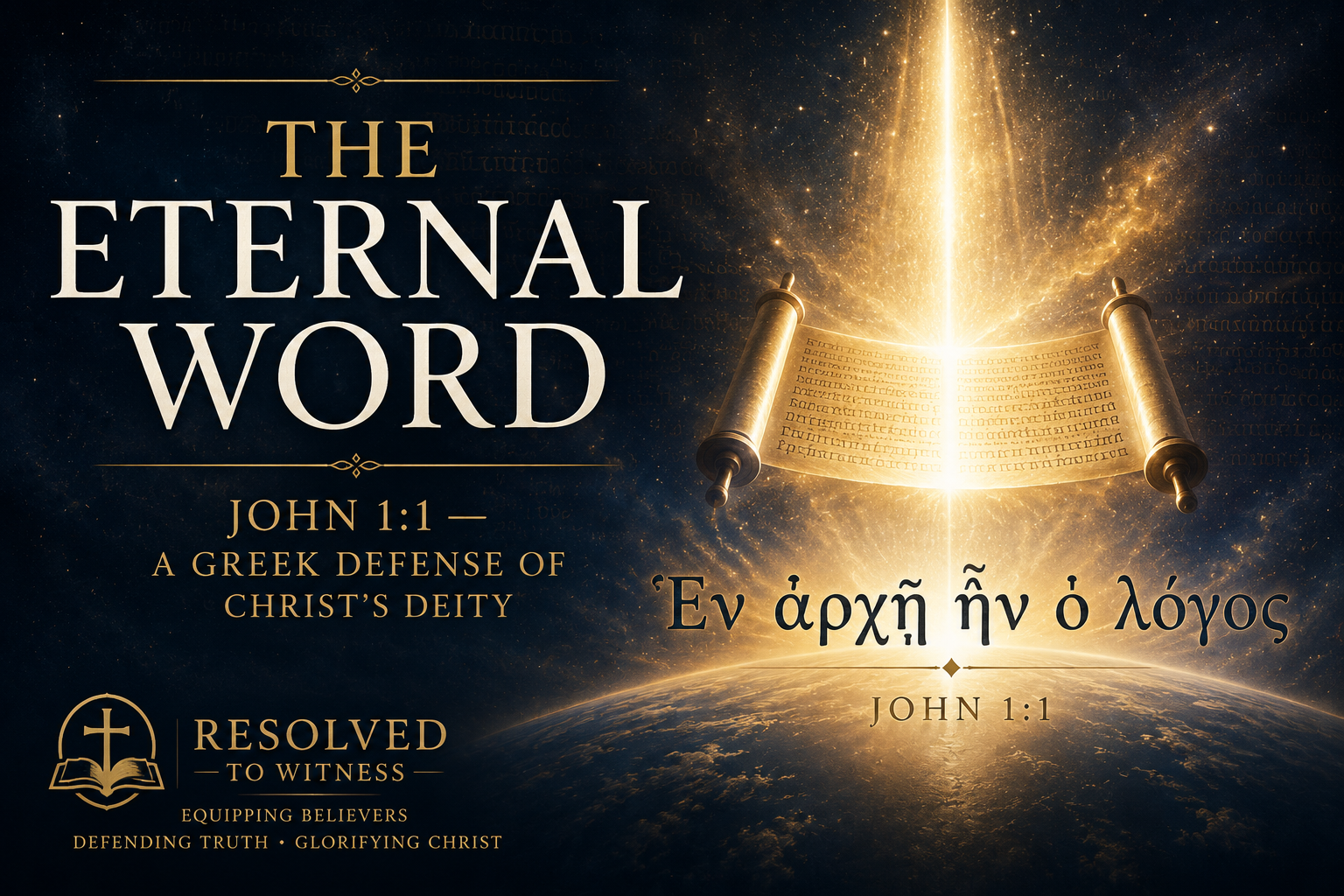
1:1a – In the beginning was the Word,
Greek – Ἐν ἀρχῇ ἦν ὁ λόγος,
Notes: The verb ēn (ἦν) is imperfect, implying continuous existence in the past, not a point of origin. “ἀρχῇ” beginning connotes the very beginning, before creation. The Logos is revealed to be Jesus in 1:14. The reading of 1:1a is very easy. Before anything was created, the Logos (word) already existed.
1:1b – and the Word was with God,
Greek – καὶ ὁ λόγος ἦν πρὸς τὸν θεόν,
Notes: The Logos is with (πρὸς) The God (τὸν θεόν). The Greek forms show the nominative form of Logos connects to the accusative form of God. The syntax in 1:1b would be understood as saying that the Logos or word is positionally and relationally toward God.
Critics of the doctrine of the trinity would use this phrasing as a point against the unity of the persons of God. The point would be that this outlines a distinction between the Logos and God.
This could be compelling if it wasn’t for the full counsel of scripture. 1:1c clearly says that the Logos is God (which we will divulge further). However, there are numerous examples of Christ’s nature being compatible with the doctrine of the Trinity (John 20:28, Titus 2:13, Isaiah 9:6, Romans 9:5, Hebrews 1:8,). Keeping within the text of the introduction of John, 1:2 says that the Logos was in the beginning with God, therefore not created. 1:3 says that all things were made through the Logos and nothing was made without him. Thus, the understanding of 1:1b along with 1:1a is that the Logos was in the beginning, with God. The Logos and The Father are two persons that share an eternal nature, yet are distinct from each other. 1:1c will reveal their connection as one being.
1:1c – and the Word was God.
καὶ θεὸς ἦν ὁ λόγος.
Notes: John uses ἦν to say “was” or “existed” in 1:1- 1:3. While in 1:14, he switches to egeneto which would connotes creation. Egeneto would be similar to saying “became” or “was made”.
Critics of the trinitarian position would look at the Greek in 1:1c and observe that Theos (θεὸς) does not have a definite article, however Logos (λόγος) does. Some would use this observation to say that the Logos was “a” God rather than the God.
However, this ignores a couple of important details concerning Greek syntax. Firstly notice the forms used for both θεὸς and λόγος are both nominative. Rather than using the structure from 1:1b, John preferred to use what we call a predicate nominative. This means that it is standard grammatical rule for a noun that precedes the verb, “ἦν” in this case, for there to only include one definite article. These two nominative nouns serve the same purpose and it would therefore render a second definite article redundant. Secondly, Theos is used to refer to God throughout scripture even when it is not always accompanied by a definite article. For example read further down in the same passage: John 1:6, 1:18. The conclusion one must draw from this text is that the Logos is the one, true God.
Overview of John 1:1
“In the beginning was the Word, and the Word was with God, and the Word was God.”
John 1:1 is a short and direct verse on the divinity of the Logos revealed to be Christ in 1:14-18. As many faithful theologians have pointed out before, the opening of John and even the rest of John’s gospel must be read through the lens of John 1:1. A closer look at this verse is a theological masterpiece that attests of the foundation of the doctrine we have dubbed, “The Trinity.” A doctrine that is simply a name that we have attributed to describe God’s true nature. The word was in the beginning before all creation, the word was with God, and the Word was God.
I pray that this study blesses you in your walk with Christ.

Leave a Reply