
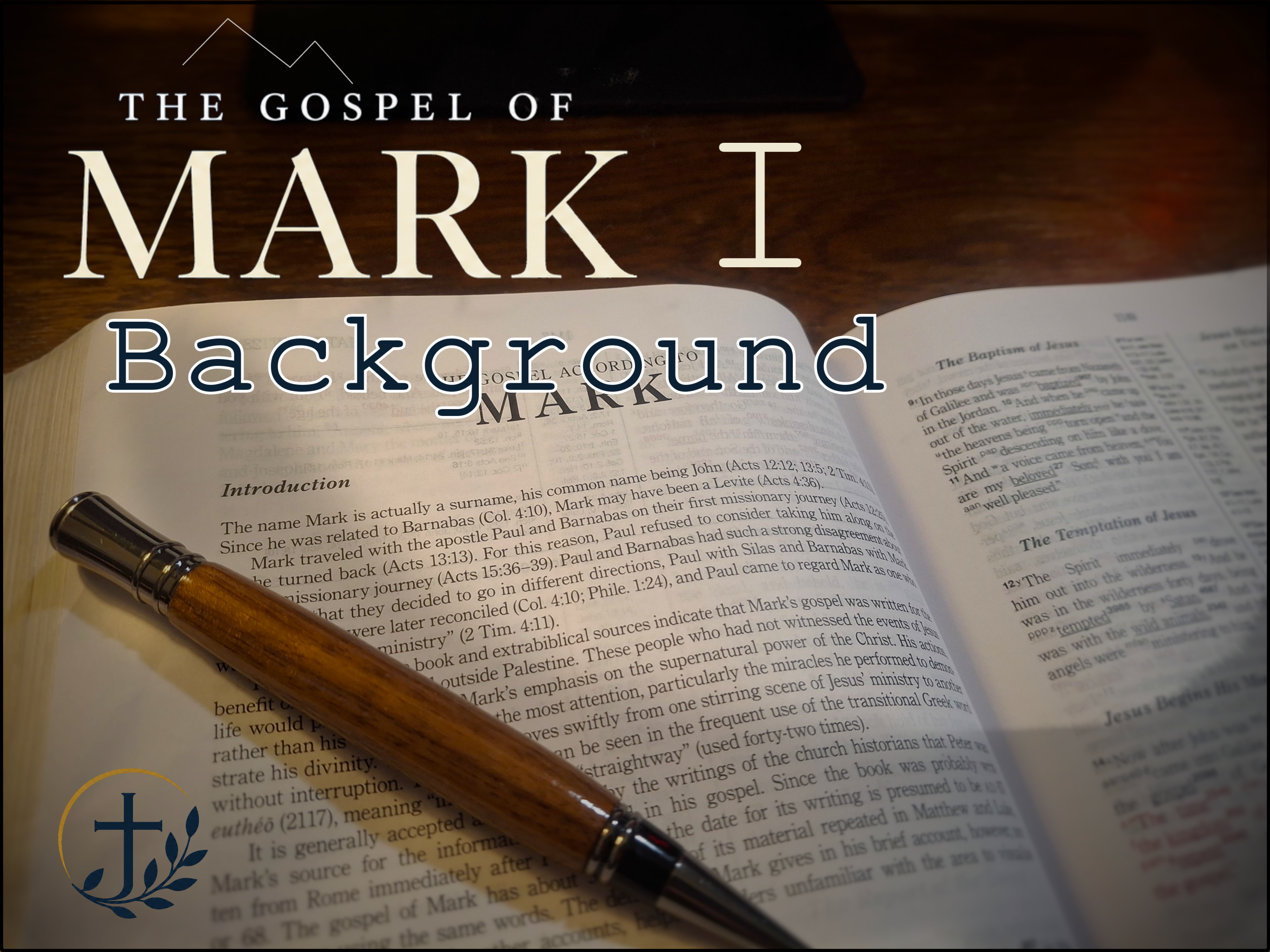
Introduction
This is my first series on this site. This is a collection of notes taken from study bibles, personal time spent researching the scripture, and my time in bible college. I believe it is beneficial for those who could range from beginners to intermediates in biblical study. This will not be groundbreaking new stuff.
Throughout Mark’s Gospel, I will be studying in my ESV study bible and using a Nestle-Aland 28th edition for my Greek. Please join me in this study and I hope you enjoy.
Learning Objectives
- Be able to explain who the author of the Gospel of Mark is.
- Understand the historical context around the Gospel of Mark.
- Understand Mark’s purpose for writing his account of the gospel.
- Be able to communicate the concepts of Markan Priority and the “Q” source.
study Content: Speculation and Examination
The Author of Mark
LO:1
The Gospel According To Mark is actually attributed to the author’s surname. Our author here, is actually named, “John Mark” (Acts 12:12; 13:5; 2 Tim. 4:11).
John Mark is a relative of Barnabas according to Col. 4:10. This is also the same John Mark that departs with Barnabas when Paul splits ways to go with Silas in Acts 15:36-39. They appear to later reconcile after some time (Col. 4:10, Phile. 1:24). Paul eventually writes to Timothy in 2 Tim 4:11 to fetch John Mark because he is useful to Paul’s ministry.
Speculation on Mark’s Witness to The Gospel
Though I don’t find it to be compelling at this time, there are is a running theory, that Mark wrote hints of his story into the gospel. This theory starts in Mark 14:51-52, where our author refers to a young man who fled naked from the Garden of Gethsemane after being seized by soldiers during Jesus’ arrest. He slipped out of his robe and pulled the surprisingly effective move of leaving his tunic behind. This detail is unique to the Gospel of Mark and does not appear in the other gospel accounts.
The idea of those who promote this theory is that you can follow John Mark’s journey from his flight from Gethsemane, to his departure from Paul in Acts, to his later appearance in Paul’s Epistle. I’ve heard this preached from the pulpit as a story of John Mark’s growth from being cowardly and weak to becoming a strong man of God. I admit it is an interesting theory but I just don’t see it. It is mostly benign but espousing this idea as truth from the pulpit requires you to read your own assumptions into the text instead of from it. I believe that the text provides enough details from Acts to Paul’s epistles on to make this point without forcing this view of Mark into the narrative.
The scholarship
LO:2
The date of writing is estimated to be approximately 68AD. It is typically agreed upon in biblical scholarship that John Mark is obtaining his information for his writings from Peter, the apostle, prior to his martyrdom in Rome. When examining early church tradition, it is traditionally agreed that Mark’s gospel was the first of the four accounts to be written. Historically, we can look back to the writings of Irenaeus in Against Heresies (~180AD) and see that even then there were only considered to be four gospels, no more, no less. Eusebius in his Ecclesiastical History (~311AD) references a first century Christian, Papias (~130AD), who recalls Apostle Peter’s teachings and says that Mark had acted as his scribe.
LO:3
The scholarship surrounding The Gospel of Mark largely agrees that Mark was writing to those who lived outside of Palestine. This is indicated by a couple of quirks in his writing style.
- Among these unique characteristics are a tendency to emphasize the supernatural nature of Christ and a rapid pace that switches from one scene to the next. This is frequently illustrated by Mark’s use of the term “immediately” (eutheō).
- Another indication that John Mark is writing to people outside of the region is that he uses very graphic and specific details, more so than the other gospels, when depicting certain scenes and geography.
- Mark also takes the time to describe Jewish customs as if the reader wasn’t familiar with them.
The inference from this observation is that he is writing to people who would be unfamiliar with the region and customs that he writes about.
In my bible college days, the phrase I heard was that this was the, “Roman Gospel”. Because the Romans would appreciate the fast paced nature of the book and it’s focus on the miraculous nature of Jesus’ ministry. This may or may not be the case, but I find the peculiar details about John Mark’s writing style to be very convincing when discussing its nature as a gospel to gentiles outside of the Palestine region.
Markan Priority and Q
LO:4
Approximately 93% of the material of Mark’s gospel is repeated in Matthew and Luke, the other synoptics. This is a common subject of conversation when considering the sources of the information for the gospels and Markan Priority. It is theorized that the authors of Matthew and Luke drew from two common sources. Under this theory, Matthew and Mark used Mark for narrative structure and a mysterious second source referred to as “Q” for the teachings that are not specifically found in Mark’s Gospel.
Using this line of thought, Mark is typically given a historically priority when reconciling the gospel accounts. This is because when one closely examining the gospels, there are times when incongruent details seem to appear. We will discuss these as we come across them in the gospel, however, what I will add here is that I have not found a single one that doesn’t have a reasonable understanding in my own study. The answers to these issues usually come down to author intent or reader overreach.
The Q source is unknown and remains a mystery to us. However, as much as modern scholarship loves to shy away from the seemingly obvious answer here, I do not. I have no shame in saying that source for all written scripture is The Holy Spirit. God weaved His words into His great tapestry of creation and the series of circumstances may have led to the event that Matthew and Luke utilized Mark’s work and one other source for writing scripture. But under the assumption that these men were first century Christians that were inspired by The Holy Spirit, of course the narrative would align! Of course there would be a source outside of Mark that led to corroborating teachings between Matthew and Luke! What I believe is an overlooked aspect of biblical study is that although God has enacted His will in many wonderful and miraculous ways, He has also always been at work in the seemingly mundane parts of life that we overlook.
Key-Takeaways
- Mark here is also the same Mark that departs with Barnabas when Paul splits ways to go with Silas in Acts.
- Mark is estimated to be written c. 68AD. Mark obtained his information for his writings from Apostle Peter prior to his martyrdom in Rome.
- Mark was writing to those who lived outside of Palestine to spread the gospel.
- ~93% of Mark’s material is repeated in the other synoptics. Markan priority is the theory that the authors of Matthew and Luke drew from two common sources. Under this theory, Matthew and Mark used Mark for narrative structure, therefore giving Mark historical priority when describing certain events. The second source referred to as “Q” is used to describe the teachings and events that are not specifically found in Mark’s Gospel.
Conclusion
For now, that covers the basics of the background we need to take a closer look at Mark. Using the context we established here, we are building a foundation for us to read Mark’s gospel with an examining eye and a discerning heart.
In part 2, we will be jumping into the first verses of Mark to explore John’s entrance onto the scene and the significance of the role he played in the gospel story.
-I pray this study blesses you in Christ.

Leave a Reply