
Introduction
I find this time to be a good opportunity to recap some of what has occurred thus far. Covering such small sections of scripture in such length can make it easy to forget how much is happening in a relatively close proximity. After Jesus’ baptism and the grand display of the Trinity, Jesus was led by The Holy Spirit to the wilderness. Jesus commonly went to be alone to pray throughout his ministry. Here is the first recorded time and it was a significant moment in Jesus’ time on Earth. interestingly, Mark mentions this as a key marker in his account of the gospel, but does not take the time to unpack the details. This is possibly due to the characteristic of Mark’s Gospel that we have mentioned several times now. That is, the typical details that would stand out to a Jew are not in view here because Mark isn’t writing to a primarily Jewish audience. But he tells them what is important for them to know.
Learning Objectives
- Be able to communicate the reason for the friction between Matthew and Luke’s account of Christ’s temptation.
- Be able to identify the doctrine of Sola Scriptura for the application of theological debate in this text.
- Be able to communicate what the gospel refers to as, “the temple” and “great buildings”.
Study Content: Verse-By-Verse Examination
1:12-13
1:12 – The Spirit immediately drove him out into the wilderness.
- In the previous edition, Jesus was baptized, announced to be The Son of God, and The Holy Spirit descended upon Him. Now, Mark tells us that The Holy Spirit led Jesus to the wilderness. Jesus’ divine mission is immediately in view.
1:13 – And he was in the wilderness forty days, being tempted by Satan. And he was with the wild animals, and the angels were ministering to him.
- Mark gives tells us of this trial but not the details. What we can immediately infer from the reading is that though Jesus was tempted, he endured temptation over a forty day period. The wild animals could be seen as a true sense of danger for Jesus or a way of marking just how far in the wilderness Jesus was.
- Then we see that angels were ministering to Jesus. Mark is highlighting that Jesus is sent, approved, and protected by God.
- Up to this point, readers must infer from the first thirteen verses of Mark that Jesus: Fulfills the prophecies of Isaiah; Is greater than Prophets; Will baptize God’s people in The Holy Spirit; Is The Son of God; Is sent by God; Is protected by God.
- (Side note: If Jesus is to baptize God’s people in The Holy Spirit, and later Jesus says that he will sender The Helper does that mean that The Holy Spirit proceeds from The Son? (See: Filioque))
The three Temptations
Because Mark does not describe the events in great detail, we will explore the other two synoptic gospels in order to gain a greater understanding of what occurred during this time.
- “Being tempted” indicates that the temptations happened over the 40 day period and were not limited to the three temptations mentioned by Matthew and Luke (Matt. 4:1–11; Luke 4:1–13).
- The importance of 40 – Numerology can be a sticky and erroneous field to get into theologically, however, a couple numbers do stand out as important as God uses them consistently to display certain correlations.
- Jesus’ 40 days of fasting in the wilderness correlates to Israel’s 40 years in the wilderness (Deut. 8:2–3).
- Moses also fasted and prayed for 40 days and nights on two occasions (Ex. 24:18; 34:28;1 Kings 19:8).
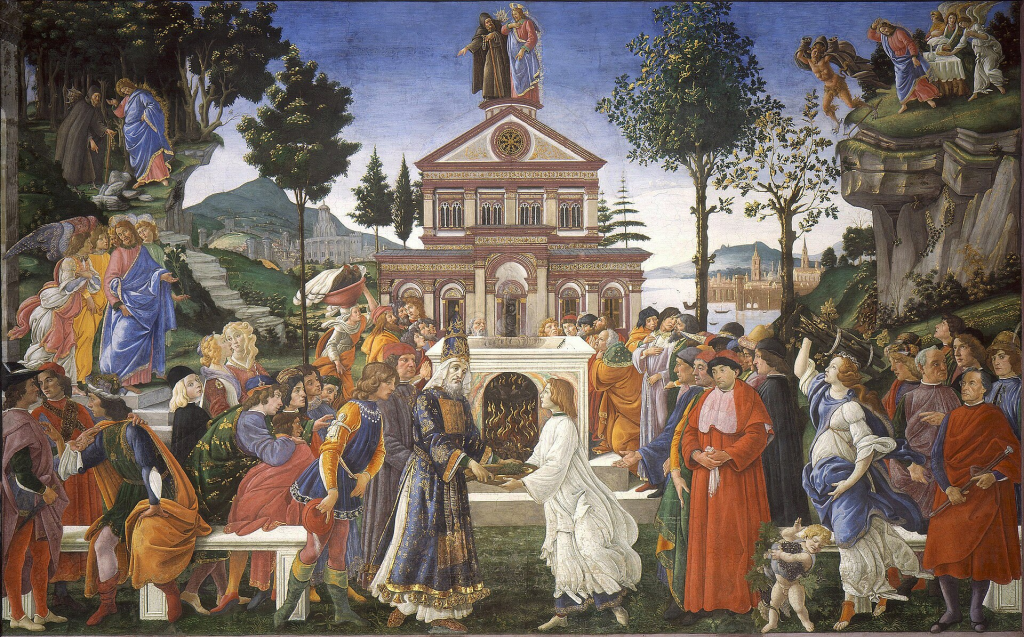
Temptations of Christ by Botticelli (1480-1482)
LO:1
- While Mark mentions the temptations, he does not explore the details of this event. However, the temptations of Christ are explored more deeply by Matthew and Luke’s account of the gospel. While Matthew and Luke’s account of Christ’s temptation are close, they are not identical. The second and third temptations are inverse to each other. This is consistent even in early manuscripts. So this is an intentional detail left by the authors. So we must ask, “why?”, “What is the purpose?” There are varied speculations on why this occurs.
- Among different speculations, one idea seems to pull from the text and allow room for the scripture to speak the most: Upon closer inspection, Matthew uses sequential language, “then this”, “then that”, to tell the story. While Luke uses compounding language, “and this”, “and that”. The idea that this builds is that while Matthew is recalling the event in a chronological sense, Luke is writing in a theologically stronger style in the order of the weakest temptation to the strongest. Make food -> worship me for power -> prove you are The Son of God.
Jesus’ Response
LO:2
- Using Matthew’s account, we will examine Jesus’ response to Satan’s temptations. I believe an interesting idea to tease out is that Jesus is the second Adam. He, going into the wilderness, was tempted by Satan. His first temptation was food. Could this be a parallel to the Genesis account of the fall of man? Also notice how Jesus responds here and in His debates later into His ministry. Jesus debates from the authority of The Scripture rather than His own divinity. This has been a point of strength for the Sola Scriptura crowd.
Matthew 4:2–11
[2] And after fasting forty days and forty nights, he was hungry.
[3] And the tempter came and said to him, “If you are the Son of God, command these stones to become loaves of bread.”
- Notice the difference in presentation from Mark and Matthew. The phrasing doesn’t seem to imply that the tempter only came after 40 days. However, it appears that this is an account of the conclusion of the fast.
[4] But he answered, “It is written, “‘Man shall not live by bread alone, but by every word that comes from the mouth of God.’”
- It is written. Jesus responds by quoting Deut. 8:2.
[5] Then the devil took him to the holy city and set him on the pinnacle of the temple
- The holy city is Jerusalem.
- The pinnacle of the temple is probably the southeast corner of the temple area, the top of which was 300 feet above the floor of the Kidron Valley
[6] and said to him, “If you are the Son of God, throw yourself down, for it is written, “‘He will command his angels concerning you,’ and “‘On their hands they will bear you up, lest you strike your foot against a stone.’”
- (Psalm 91:11-12)
[7] Jesus said to him, “Again it is written, ‘You shall not put the Lord your God to the test.’”
- (Deuteronomy 6:16)
[8] Again, the devil took him to a very high mountain and showed him all the kingdoms of the world and their glory.
[9] And he said to him, “All these I will give you, if you will fall down and worship me.”
[10] Then Jesus said to him, “Be gone, Satan! For it is written, “‘You shall worship the Lord your God and him only shall you serve.’”
- (Deuteronomy 6:13) (Deuteronomy 10:20)
[11] Then the devil left him, and behold, angels came and were ministering to him.
Additional Details
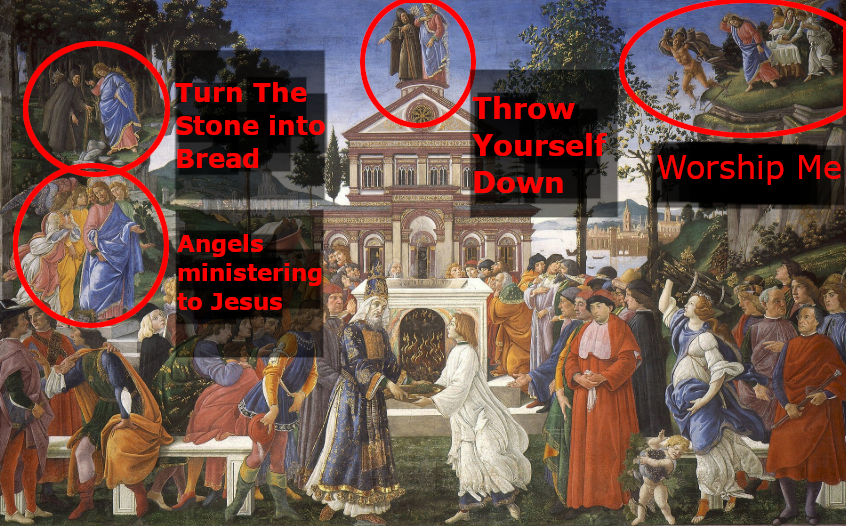
- In Botticelli’s work, Satan is depicted as a robed hermit who takes Jesus from the wilderness to tempt Him.
- The foreground depicts a high priest performing the cleansing miracle for a leper.
- This is all to depict Christ’s fulfillment of the law and his high priestly role.
- The foreground depicts a high priest performing the cleansing miracle for a leper.
LO:4
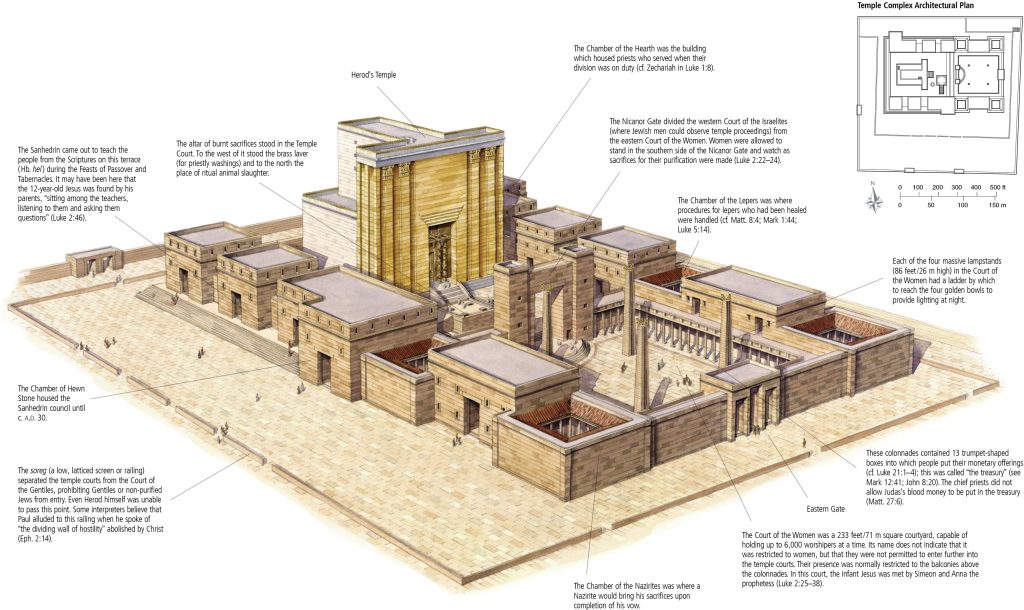
- The temple from Botticelli’s work is likely representing a contemporary idea of the temple and not the historically accurate depiction here.
- When the Gospel and the book of Acts refer to entering the temple , it is often not a reference to Herod’s temple itself, but rather the complex containing the temple, this includes a number of surrounding structures including courts and chambers around the temple. (See image below).
- Matt. 24:1 – Jesus left the temple and was going away, when his disciples came to point out to him the buildings of the temple.
- Mark 13:1-2 – And as he came out of the temple, one of his disciples said to him, “Look, Teacher, what wonderful stones and what wonderful buildings!” And Jesus said to him, “Do you see these great buildings? There will not be left here one stone upon another that will not be thrown down.”
- When the Gospel and the book of Acts refer to entering the temple , it is often not a reference to Herod’s temple itself, but rather the complex containing the temple, this includes a number of surrounding structures including courts and chambers around the temple. (See image below).
Key-Takeaways
- Matthew is recalling the event in a chronological sense, Luke is writing in a theologically stronger style in the order of the weakest temptation to the strongest.
- Jesus debates from the authority of The Scripture.
- When the Gospel and the book of Acts refer to entering the temple , it is often not a reference to Herod’s temple itself, but rather the complex containing the temple, this includes a number of surrounding structures including courts and chambers around the temple.
Conclusion
Here concludes another edition of a very small amount of scripture, but a very dense level of detail. I intend to cover a slightly larger portion of scripture in the next section. While I could’ve followed Mark’s flow during this edition, I opted to demonstrate how the gospels interact and support each-other. I am really enjoying unpacking the art as well. I hope this blesses you.
-In Christ

Leave a Reply