Jesus is the son of God.
This is a beautiful truth of Christianity that has always been acknowledged since God himself revealed this truth to us. However, there is an even more beautiful and amazing truth in Christianity.
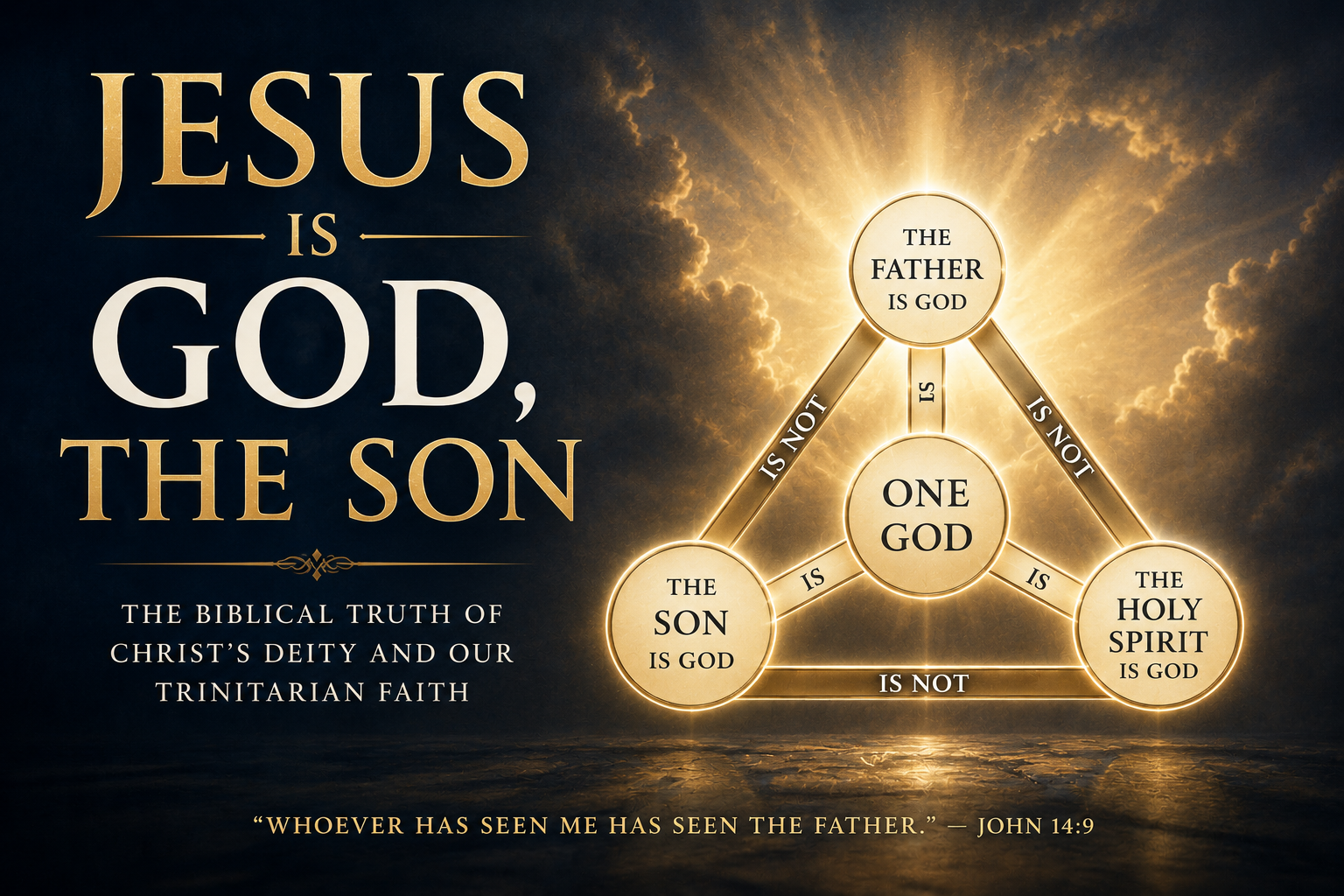
Jesus is God, The Son.
Historically, this statement has been harder to fully comprehend and communicate. Even today, many struggle with defining the relationship of the Father and Son correctly. There is also a lot of misinformation surrounding this subject that has caused much of a headache for a orthodox trinitarians.
However, those who actively obfuscate this topic with nonsensical theology must actively fight against scripture and the theology of the early church to come to a conclusion that echoes some flavor of Arianism, Modalism, tritheism, or any other heretical ‘ism’.
Thankfully, while God’s nature is difficult to conceptualize, it is communicable. Here, we will build a solid foundation for understanding God’s nature and person.
The Being of God
- Isaiah 45:5 – I am the Lord, and there is no other apart from me there is no God.
- Psalm 90:2 – Before the mountains were brought forth, or ever you had formed the earth and the world, from everlasting to everlasting you are God.
- Isaiah 46:10 – declaring the end from the beginning and from ancient times things not yet done, saying, ‘My counsel shall stand, and I will accomplish all my purpose,’
- Nehemiah 9:5 – Then the Levites, Jeshua, Kadmiel, Bani, Hashabneiah, Sherebiah, Hodiah, Shebaniah, and Pethahiah, said, “Stand up and bless the LORD your God from everlasting to everlasting. Blessed be your glorious name, which is exalted above all blessing and praise.
- Malachi 3:6 – For I the Lord do not change; therefore you, O children of Jacob, are not consumed.
Homoousias – Of the same substance.
This term is what is used to technically describe the relationship of The Father, God and The Son, Jesus. What is meant by this term is that they are of the same substance, essence, and/or nature. But their personhoods are distinct and co-equal. There was a need for a communicable term of the trinitarian God’s nature and thus they began teasing out the exact definitions from concepts in scripture. The result was our term, “Homoousias”. This was to communicate that there is only one true, eternal being called God, YHWH.
To summative bring a definition to this being: God is the creator of all things who has revealed himself as a covenantal and personal God, who is also ultimate and beyond creation. He is the beginning and the end. He was, and is, and is to come. From everlasting to everlasting YHWH is God. He alone is holy and worthy of all praise.
Persons of God:
- John 1:1 – In the beginning was the Word, and the Word was with God, and the Word was God. He was in the beginning with God. All things were made through him, and without him was not any thing made that was made.
- 1:1C – “and The Word was God” – καὶ θεὸς ἦν ὁ λόγος
- Even though many try to make this phrase say something besides what it is literally translated to say. These words in Greek and in English can only mean that Jesus is God when properly studied.
- 1:1C – “and The Word was God” – καὶ θεὸς ἦν ὁ λόγος
- John 1:14 – And the Word became flesh and dwelt among us, and we have seen his glory, glory as of the only Son
- John 1:18 – No one has ever seen God; the only God, who is at the Father’s side, he has made known.
- John 14:9 – Jesus said to him, “Have I been with you so long, and you still do not know me, Philip? Whoever has seen me has seen the Father. How can you say, ‘Show us the Father’?
- John 20:28 – Thomas answered him, “My Lord and my God!”
- Colossians 1:15-19 – He is the image of the invisible God, the firstborn of all creation. For by him all things were created, in heaven and on earth, visible and invisible, whether thrones or dominions or rulers or authorities—all things were created through him and for him. And he is before all things, and in him all things hold together. And he is the head of the body, the church. He is the beginning, the firstborn from the dead, that in everything he might be preeminent. For in him all the fullness of God was pleased to dwell,
- Note: “first-born” is protokos in Greek. Some read into that word that it means “created”. It means “pre-eminent” and denotes supremacy. Which is evident by the later parts of the passage where it says that he created all things.
- Hebrews 1:3 – He is the radiance of the glory of God and the exact imprint of his nature, and he upholds the universe by the word of his power. After making purification for sins, he sat down at the right hand of the Majesty on high,
- Jesus is the exact imprint of God’s nature and he upholds the universe by the word of his power.
- Hebrews 1:6 – And again, when he brings the firstborn into the world, he says, “Let all God’s angels worship him.”
- Hebrews 1:8 – But of the Son he says, “Your throne, O God, is forever and ever, the scepter of uprightness is the scepter of your kingdom.
Now for a biblical conclusion of the persons of God: This being, God, alone has the true substance (essence) of God. But God, referred to as the Father, revealed his only begotten Son, Jesus. In scripture, Jesus is worshipped and referred to as God. Jesus reveals himself as the same God who existed before Moses. However, Jesus is also distinct from The Father. Jesus is the son of God, yet also God, The Son. He created all things and upholds them, he is the exact imprint of the nature of God, but also sits next to God in heaven. The person of God by the Father’s side is called, “The only God.” Jesus also says if you see him, you see The Father.
The only conclusion can be one God, separate persons.
The Council of Nicea
In 325, The Nicene Council met to clarify the biblical position on Jesus’ deity due to Arius’s denial of the divinity of Christ. With a lot of debating back and forth between the Orthodox and the Arians, as well as appealing to the emperor. What eventually came out was the Nicene Creed, an adaptation from the earlier Apostles’ Creed, with refined wording so that Jesus’ humanity and divinity were more clearly understood under one theological statement.
The Nicene Creed
I believe in one God, the Father almighty, maker of heaven and earth,of all things visible and invisible.
I believe in one Lord Jesus Christ, the Only Begotten Son of God, born of the Father before all ages.
God from God, Light from Light, true God from true God, begotten, not made, consubstantial with the Father; through him all things were made.
For us men and for our salvation he came down from heaven, and by the Holy Spirit was incarnate of the Virgin Mary, and became man.
For our sake he was crucified under Pontius Pilate, he suffered death and was buried, and rose again on the third day in accordance with the Scriptures.
He ascended into heaven and is seated at the right hand of the Father.
He will come again in glory to judge the living and the dead and his kingdom will have no end.
I believe in the Holy Spirit, the Lord, the giver of life, who proceeds from the Father and the Son, who with the Father and the Son is adored and glorified, who has spoken through the prophets.
I believe in one, holy, catholic and apostolic Church.
I confess one Baptism for the forgiveness of sins and I look forward to the resurrection of the dead and the life of the world to come.
Amen.
Conclusion
The doctrine of the trinity is not simply philosophy. It is definitely historical, but it is not only that. It is divine revelation. One God. Three Persons. Blessed Trinity.
Recommended Reading on this subject:
The Story of Christianity Part I by Justo L Gonzales, A New Eusebius by W.H.C Frend, The Forgotten Trinity by Dr. James White.
-In Christ

Leave a Reply